Technology
Learn about the platform powering today's most advanced automation applications

Technology
Learn about the platform powering today's most advanced automation applications
Technology
Learn about the platform powering today's most advanced automation applications

Why Traditional Robot Programming Doesn’t Scale in Modern Warehouses
Why Traditional Robot Programming Doesn’t Scale in Modern Warehouses
From Robot Teaching to Teachless Automation
Industrial robots have transformed manufacturing and logistics, performing repetitive tasks with speed, accuracy, and consistency. But as warehouses and factories become more dynamic, the way many robots are programmed is becoming a limitation.
Traditional industrial robotics relies heavily on teaching. Engineers define positions, program sequences, create robot paths, and configure how the system should respond to expected conditions. This works well when the environment is predictable and the same operation is repeated thousands of times.
Modern operations are increasingly different.
SKU mixes change. Packaging varies. Products arrive in unpredictable positions. Production requirements evolve. Warehouse layouts change. Yet automation is expected to keep performing without constant engineering intervention.
The challenge is therefore no longer simply how to automate a task. It is how to build robotic systems that can adapt as the operation changes.
This is where teachless robotics and software-defined automation offer a different approach.
Why Traditional Robot Programming Becomes a Problem
Traditional robot programming is built around predefined behavior.
An engineer typically teaches the robot the positions and movements required to complete a task. For predictable applications, this provides reliable and repeatable performance.
The difficulty appears when conditions change.
A new product may require a new program. A different pallet pattern may require additional logic. A changed workcell layout can require robot paths to be updated. Unexpected object positions can create situations the original program was never designed to handle.
Teaching one predictable task is manageable. Teaching every possible variation is not.
Consider a warehouse handling a large and constantly changing range of SKUs. Cases can differ in dimensions, weight, material, orientation, and packaging. Pallets may arrive with different stacking patterns, while cases can shift during transportation.
Trying to explicitly program every possible situation quickly becomes impractical.
As automation expands across a facility or multiple sites, the challenge grows. If every robotic cell requires significant custom programming, scaling automation also means scaling engineering effort.
For warehouse and factory operators, this can make automation harder to adapt as products and processes change. For system integrators, it can make deployments more engineering-intensive and difficult to standardise.
The more variable the environment becomes, the less practical it is to define every robot movement in advance.
What Is Teachless Robotics?
Teachless robotics changes the role of robot programming.
Instead of manually defining every position and trajectory, the automation system is configured around the task, environment, equipment, and operational requirements.
The system then determines how the robot should perform the task.
This requires more than removing a teach pendant from the process. A teachless robotic system needs to understand its environment, determine what action is required, calculate how to execute that action safely, and respond when conditions change.
With MujinOS, these capabilities are brought together within one robotics platform.
Rather than simply replaying a predefined sequence, the robot can calculate how to accomplish its assigned task based on the current conditions within the workcell.
How MujinOS Makes Teachless Robotics Possible
Teachless automation depends on several technologies working together.
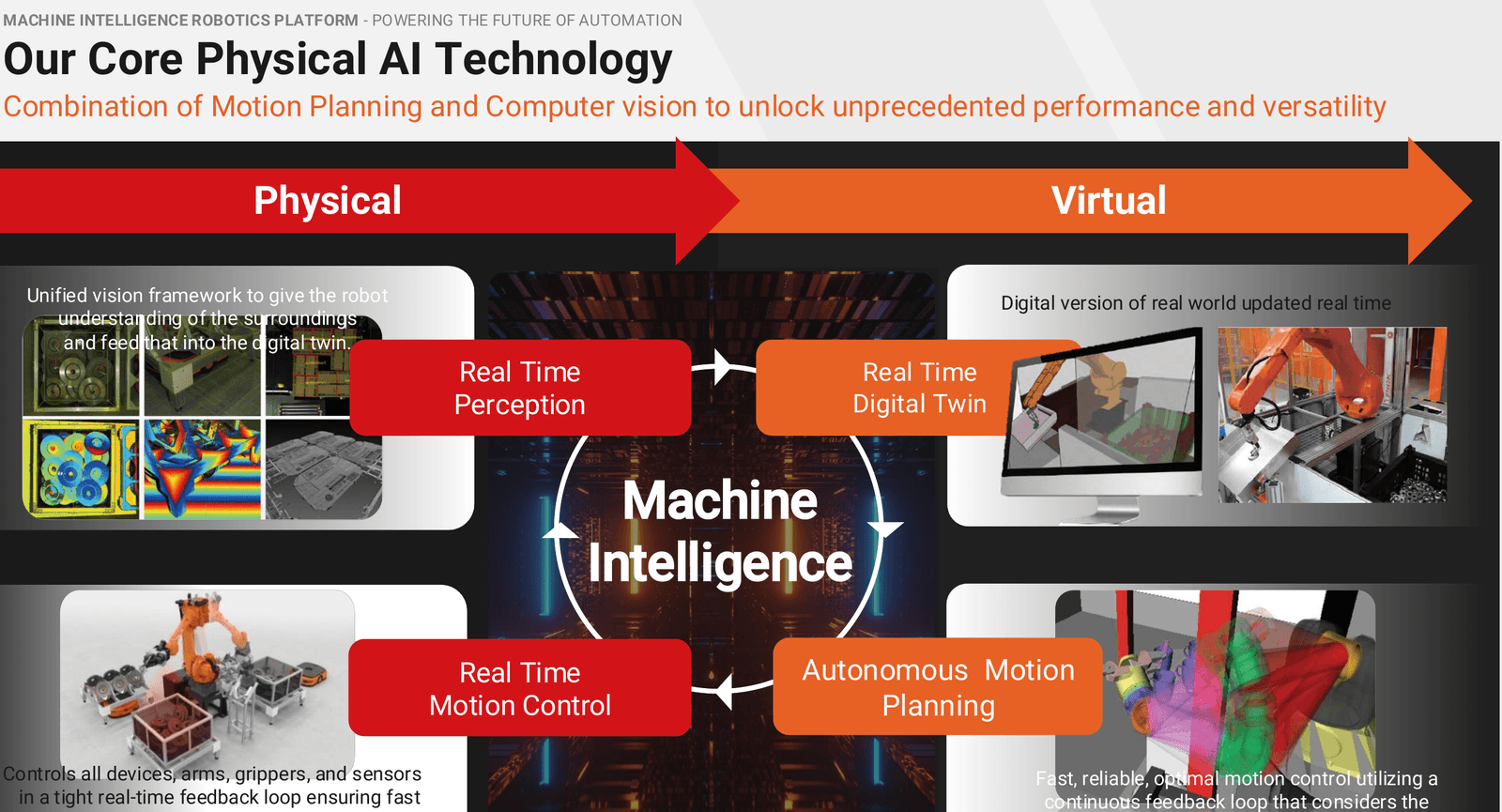
1. Perceive the Environment
Before a robot can decide how to move, it needs to understand what is happening around it.
MujinOS uses real-time perception to identify relevant objects and understand their position within the workcell.
This is particularly important for applications such as depalletizing, where every pallet can be different. Cases may shift during transportation, layers may not be perfectly aligned, and products can vary in size and orientation.
The robot cannot rely on every object being exactly where it was expected to be.
2. Real-Time Digital Twin
MujinOS uses a digital twin to maintain a model of the robot, surrounding equipment, objects, and physical constraints within the workcell.
This gives the system the spatial context required to determine how the robot can move.
While digital twins are often associated with offline simulation or system design, within MujinOS the digital twin also plays an active role during operation.
It provides the environment against which robot movements can be calculated and validated.
3. Motion Planning
In a conventional robotic system, many movements are programmed in advance. Engineers define waypoints and trajectories that the robot follows during operation.
MujinOS instead uses real-time motion planning.
Once the system understands the environment, it calculates a collision-free trajectory based on the current state of the workcell.
If the position of a case changes, for example, the system can calculate the movement required for that situation rather than relying only on a previously taught trajectory.
The robot therefore does not need every possible movement to be manually programmed beforehand.
4. Execute and Adapt
Once a path has been calculated, the robot executes the task.
As the environment changes, the process repeats.
This enables robotic systems to respond to real-world variability rather than requiring the environment to remain perfectly predictable.
From Programming Robots to Configuring Applications
Teachless robotics does not mean engineering disappears.
It changes where engineering effort is spent.
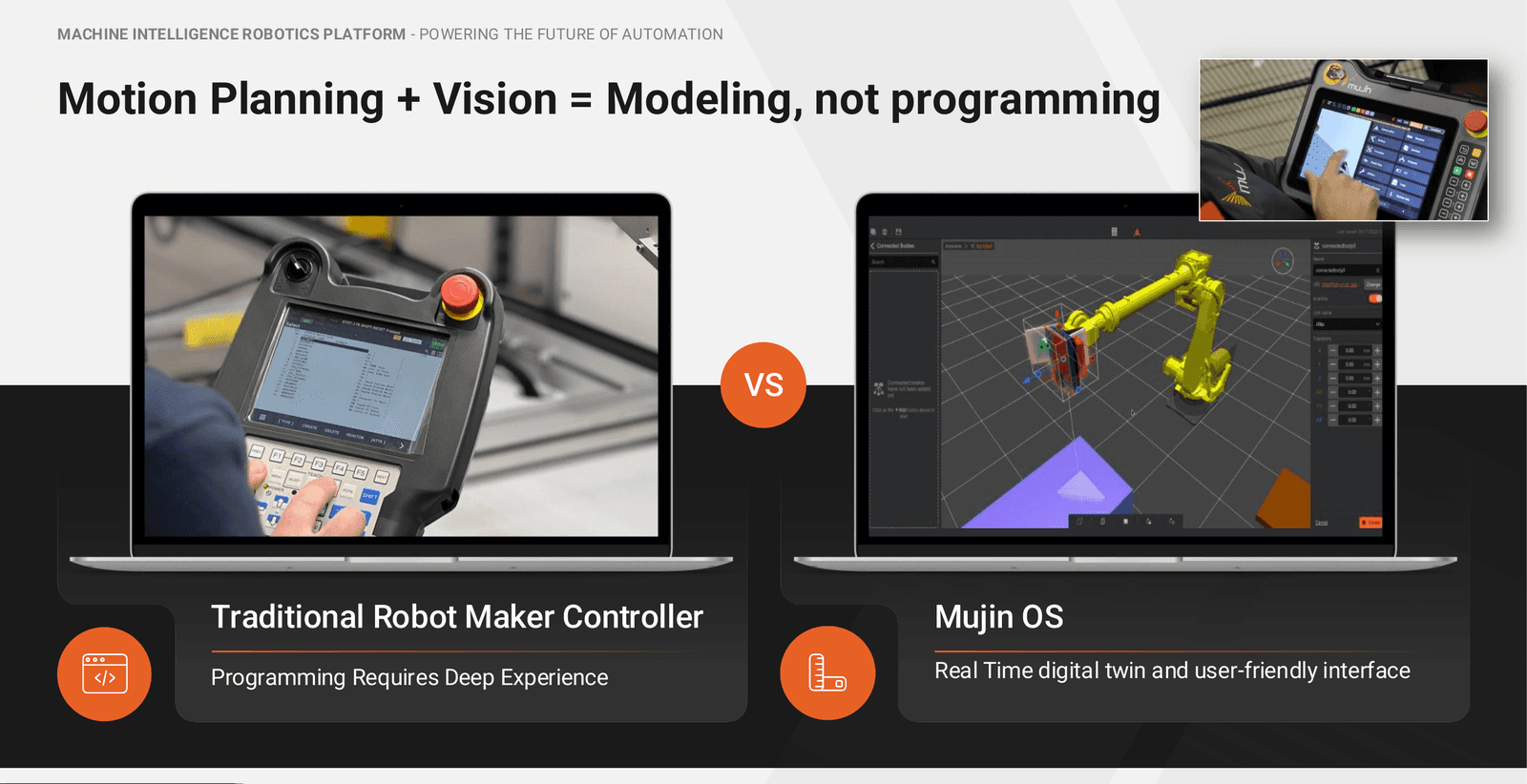
Instead of manually defining large numbers of robot movements, engineers can focus more on the application itself: the process, system layout, equipment, safety requirements, throughput targets, and interaction between different components.
MujinOS provides pre-built automation applications that system integrators can configure rather than program from the ground up.
The workflow moves closer to:
Select the automation application
Define the robotic workcell and equipment
Configure application parameters
Validate the system
Deploy
The underlying platform handles capabilities such as perception, motion generation, collision avoidance, and robot control.
This approach can reduce repetitive programming and make application knowledge easier to reuse across deployments.
It also reduces dependence on individual robot brands.
Different robot manufacturers traditionally have different controllers, programming languages, and engineering environments. MujinOS provides a common software foundation for controlling supported robots and automation equipment from multiple manufacturers.
For operators, this provides greater flexibility when selecting hardware. For integrators, it creates an opportunity to standardise more of the automation architecture across projects instead of developing a different control approach for every robot platform.
The goal is not simply to make one robot easier to program.
It is to make robotic automation easier to repeat and scale.
Automation Designed for Change
Traditional robot programming remains effective for predictable, repetitive applications.
But modern warehouses and factories increasingly operate in environments defined by product variation, changing workflows, and growing automation complexity.
In these environments, manually teaching every possible robot action becomes increasingly difficult to scale.
Teachless robotics provides another approach.
By combining real-time perception, digital twin technology, motion planning, and hardware-agnostic robot control, MujinOS enables robots to respond to the current environment rather than relying entirely on predefined movements.
For system integrators, this can mean a more repeatable approach to building and deploying robotic applications.
For operators, it means automation designed to adapt as products and processes change.
The future of industrial robotics is therefore not simply about programming robots faster.
It is about reducing how much robot programming is needed in the first place.
Learn more about MujinOS and how software-defined robotics can enable more flexible, scalable automation.
From Robot Teaching to Teachless Automation
Industrial robots have transformed manufacturing and logistics, performing repetitive tasks with speed, accuracy, and consistency. But as warehouses and factories become more dynamic, the way many robots are programmed is becoming a limitation.
Traditional industrial robotics relies heavily on teaching. Engineers define positions, program sequences, create robot paths, and configure how the system should respond to expected conditions. This works well when the environment is predictable and the same operation is repeated thousands of times.
Modern operations are increasingly different.
SKU mixes change. Packaging varies. Products arrive in unpredictable positions. Production requirements evolve. Warehouse layouts change. Yet automation is expected to keep performing without constant engineering intervention.
The challenge is therefore no longer simply how to automate a task. It is how to build robotic systems that can adapt as the operation changes.
This is where teachless robotics and software-defined automation offer a different approach.
Why Traditional Robot Programming Becomes a Problem
Traditional robot programming is built around predefined behavior.
An engineer typically teaches the robot the positions and movements required to complete a task. For predictable applications, this provides reliable and repeatable performance.
The difficulty appears when conditions change.
A new product may require a new program. A different pallet pattern may require additional logic. A changed workcell layout can require robot paths to be updated. Unexpected object positions can create situations the original program was never designed to handle.
Teaching one predictable task is manageable. Teaching every possible variation is not.
Consider a warehouse handling a large and constantly changing range of SKUs. Cases can differ in dimensions, weight, material, orientation, and packaging. Pallets may arrive with different stacking patterns, while cases can shift during transportation.
Trying to explicitly program every possible situation quickly becomes impractical.
As automation expands across a facility or multiple sites, the challenge grows. If every robotic cell requires significant custom programming, scaling automation also means scaling engineering effort.
For warehouse and factory operators, this can make automation harder to adapt as products and processes change. For system integrators, it can make deployments more engineering-intensive and difficult to standardise.
The more variable the environment becomes, the less practical it is to define every robot movement in advance.
What Is Teachless Robotics?
Teachless robotics changes the role of robot programming.
Instead of manually defining every position and trajectory, the automation system is configured around the task, environment, equipment, and operational requirements.
The system then determines how the robot should perform the task.
This requires more than removing a teach pendant from the process. A teachless robotic system needs to understand its environment, determine what action is required, calculate how to execute that action safely, and respond when conditions change.
With MujinOS, these capabilities are brought together within one robotics platform.
Rather than simply replaying a predefined sequence, the robot can calculate how to accomplish its assigned task based on the current conditions within the workcell.
How MujinOS Makes Teachless Robotics Possible
Teachless automation depends on several technologies working together.
1. Perceive the Environment
Before a robot can decide how to move, it needs to understand what is happening around it.
MujinOS uses real-time perception to identify relevant objects and understand their position within the workcell.
This is particularly important for applications such as depalletizing, where every pallet can be different. Cases may shift during transportation, layers may not be perfectly aligned, and products can vary in size and orientation.
The robot cannot rely on every object being exactly where it was expected to be.
2. Real-Time Digital Twin
MujinOS uses a digital twin to maintain a model of the robot, surrounding equipment, objects, and physical constraints within the workcell.
This gives the system the spatial context required to determine how the robot can move.
While digital twins are often associated with offline simulation or system design, within MujinOS the digital twin also plays an active role during operation.
It provides the environment against which robot movements can be calculated and validated.
3. Motion Planning
In a conventional robotic system, many movements are programmed in advance. Engineers define waypoints and trajectories that the robot follows during operation.
MujinOS instead uses real-time motion planning.
Once the system understands the environment, it calculates a collision-free trajectory based on the current state of the workcell.
If the position of a case changes, for example, the system can calculate the movement required for that situation rather than relying only on a previously taught trajectory.
The robot therefore does not need every possible movement to be manually programmed beforehand.
4. Execute and Adapt
Once a path has been calculated, the robot executes the task.
As the environment changes, the process repeats.
This enables robotic systems to respond to real-world variability rather than requiring the environment to remain perfectly predictable.
From Programming Robots to Configuring Applications
Teachless robotics does not mean engineering disappears.
It changes where engineering effort is spent.
Instead of manually defining large numbers of robot movements, engineers can focus more on the application itself: the process, system layout, equipment, safety requirements, throughput targets, and interaction between different components.
MujinOS provides pre-built automation applications that system integrators can configure rather than program from the ground up.
The workflow moves closer to:
Select the automation application
Define the robotic workcell and equipment
Configure application parameters
Validate the system
Deploy
The underlying platform handles capabilities such as perception, motion generation, collision avoidance, and robot control.
This approach can reduce repetitive programming and make application knowledge easier to reuse across deployments.
It also reduces dependence on individual robot brands.
Different robot manufacturers traditionally have different controllers, programming languages, and engineering environments. MujinOS provides a common software foundation for controlling supported robots and automation equipment from multiple manufacturers.
For operators, this provides greater flexibility when selecting hardware. For integrators, it creates an opportunity to standardise more of the automation architecture across projects instead of developing a different control approach for every robot platform.
The goal is not simply to make one robot easier to program.
It is to make robotic automation easier to repeat and scale.
Automation Designed for Change
Traditional robot programming remains effective for predictable, repetitive applications.
But modern warehouses and factories increasingly operate in environments defined by product variation, changing workflows, and growing automation complexity.
In these environments, manually teaching every possible robot action becomes increasingly difficult to scale.
Teachless robotics provides another approach.
By combining real-time perception, digital twin technology, motion planning, and hardware-agnostic robot control, MujinOS enables robots to respond to the current environment rather than relying entirely on predefined movements.
For system integrators, this can mean a more repeatable approach to building and deploying robotic applications.
For operators, it means automation designed to adapt as products and processes change.
The future of industrial robotics is therefore not simply about programming robots faster.
It is about reducing how much robot programming is needed in the first place.
Learn more about MujinOS and how software-defined robotics can enable more flexible, scalable automation.
Media contact
marketing@mujin-europe.com
Have a question?
Learn how MujinOS delivers real-time perception, motion control, and no-code deployment—across any robotic system
Have a question?
Learn how MujinOS delivers real-time perception, motion control, and no-code deployment—across any robotic system