

Case Study
Sango Japan
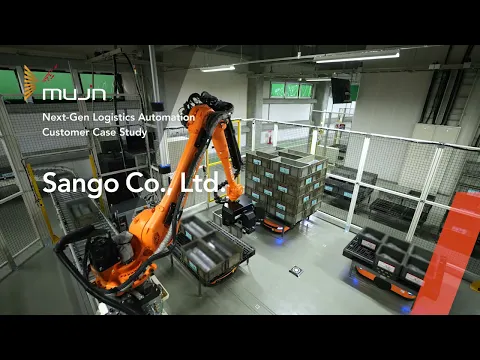
Sango transformed its factory logistics operations with a fully automated finished goods warehouse powered by MujinOS. By integrating depalletizing robots, 18 AGVs, warehouse control software (WCS), and digital twin technology, the solution automates the transport, storage, and shipment sorting of automotive components while significantly reducing logistics costs and improving operational efficiency.
Challenge
Sango previously stored finished products in an off-site warehouse before transporting them back to the factory for shipment. As production volumes increased and labor shortages, rising transportation costs, and a shortage of truck drivers continued to impact the manufacturing sector, the company sought a more efficient and sustainable logistics model.
To address these challenges, Sango planned the construction of a new finished goods warehouse within its factory premises. The objective was to reduce logistics costs, improve operational efficiency, create a more attractive working environment for employees, and establish a foundation for long-term factory logistics transformation.
Solution
Mujin worked closely with Sango throughout the project, providing logistics analysis, warehouse layout design, and WES requirements planning. The resulting solution combines two autonomous depalletizing robots, 18 AGVs, and multiple automated material handling systems under a single warehouse control platform powered by MujinOS.
The system automates the transportation, storage, inventory management, and shipment sorting of automotive components while providing real-time visibility through digital twin technology. By orchestrating all warehouse operations from a unified platform, Sango created a highly efficient and scalable factory logistics environment.
Results
Reduced first-year logistics costs by approximately ¥140 million through logistics optimization.
Reduced manual logistics labor requirements by 67%.
Eliminated approximately 2,080 truck journeys per year between the factory and external warehouse facilities.
Reduced annual CO₂ emissions by approximately 11.9 tonnes.
Shortened lead times from production to shipment.
Improved inventory accuracy and prevented overproduction through real-time inventory visibility and digital twin technology.
Enabled employees to focus on higher-value manufacturing and continuous improvement activities.
Automated handling of returnable containers weighing up to 15 kg, reducing physical workload by approximately 18 tonnes per operator per day.
Key Technologies
Unified WES
Centralized control of two depalletizing robots, 18 AGVs, safety systems, vertical conveyors, automatic elevators, and case conveyor systems through a single platform.
Teachless Depalletizing Robots
Mujin’s intelligent robot controller automatically calculates optimal gripping and motion paths, enabling flexible handling of a wide variety of returnable containers without manual robot teaching.
Dynamic Inventory Management
Flexible storage location allocation based on production demand, enabling inventory optimization and reducing excess stock.
Digital Twin Visualization
Real-time visualization of warehouse operations and inventory data, accelerating digital transformation and allowing employees to focus on higher-value tasks.