Technology
Learn about the platform powering today's most advanced automation applications


Technology
Learn about the platform powering today's most advanced automation applications
Technology
Learn about the platform powering today's most advanced automation applications
Unregistered Depalletizing: How MujinOS Enables Teachless, Autonomous Robots
Unregistered Depalletizing: How MujinOS Enables Teachless, Autonomous Robots
Making Robots Truly Intelligent with MujinOS
Humans, in most cases, know what they are doing. When depalletizing, a person visually scans the pallet, identifies the products, and starts lifting them one by one. Sometimes we recognize each item; other times we simply grab a case without thinking much about it. Once the product is in our hands, we place it on a conveyor — and the task is done.
A traditional robot operates in a similar way. It replaces the human in executing preprogrammed arm movements. Cameras act as its eyes, locating products — or sometimes estimating where they might be. A gripper serves as its hands, attempting to pick up each item. The robot then repeats these actions over and over again.
In both cases — human and robot — the task is forgotten once it’s completed. The difference is that while humans can solve unexpected issues, robots typically need human assistance when something goes wrong.
At Mujin, we aim to make robots truly intelligent. With MujinOS, we want robots not only to perform actions but to understand what they are doing — and, when uncertain, to find ways to ensure each task is executed correctly. These are not simple repetitive motions; as task variation increases, so does the challenge.
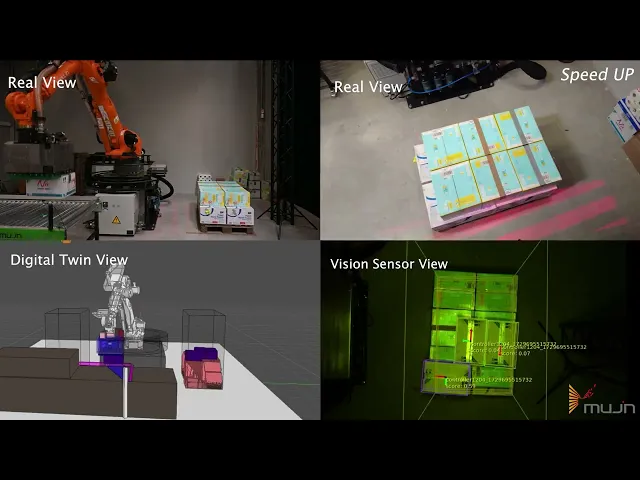
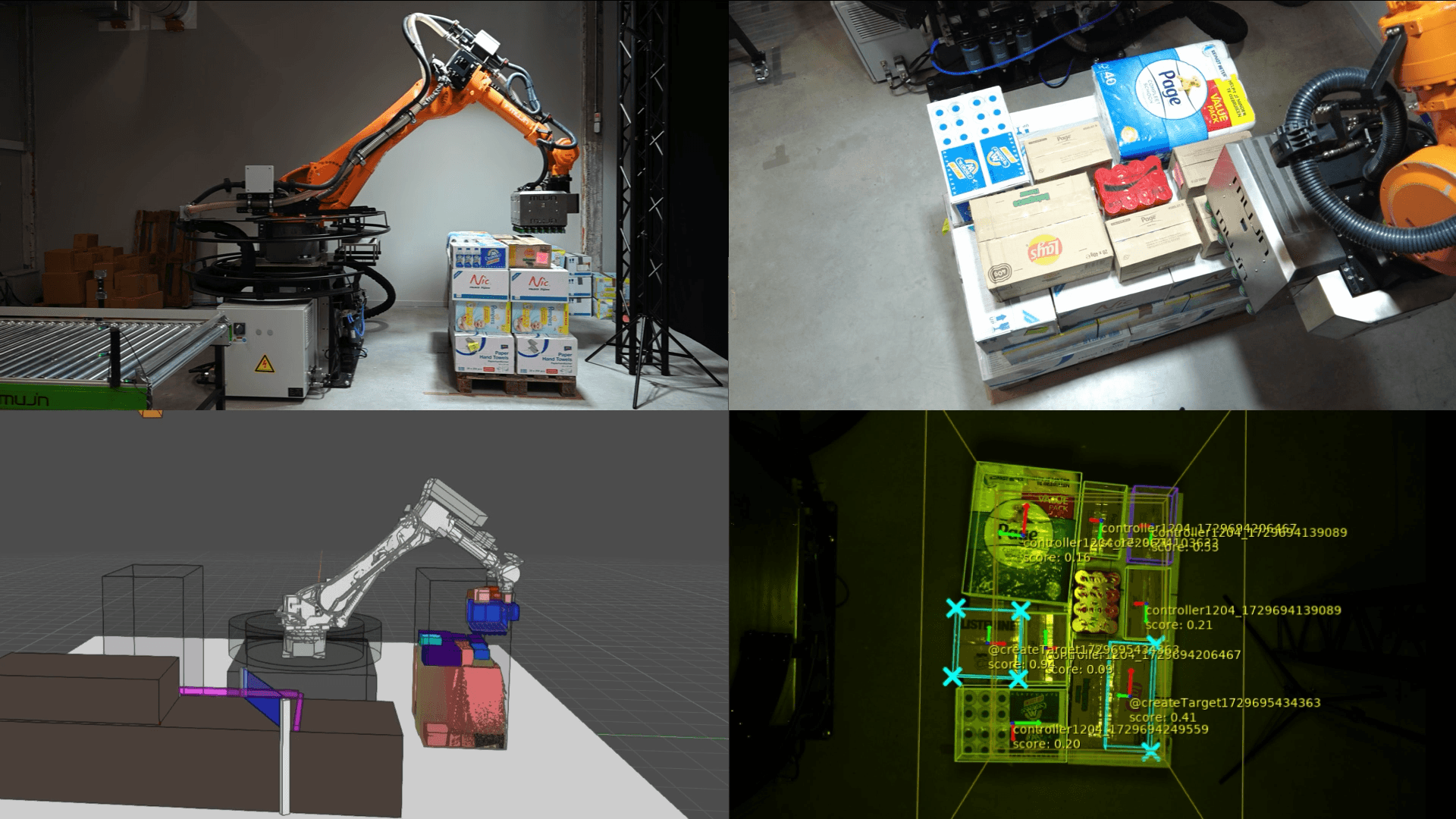
In the accompanying video, you can see four screens. The top two show the real-world environment. The bottom-left screen displays the core of MujinOS — the digital twin. Within this digital twin, the system plans and executes all tasks, with real-time results visible both digitally and in the physical world. The bottom-right screen shows what the system’s cameras detect; when a product is identified, it also appears in the digital twin.
Planning to automate depalletizing or order fulfillment? Contact Us
As the robot performs its tasks, it continuously captures and stores relevant 2D and 3D data — including dimensions and weights. This data collection enables MujinOS to recognize products more quickly, allowing the robot to execute future tasks more efficiently. It also builds a historical record that supports maintenance, quality assurance, and order verification — effectively serving as proof of delivery.
All of this happens locally. MujinController runs MujinOS entirely on-site, with no need for cloud services or external AI servers — enhancing both performance and cybersecurity.
Through this intelligent data processing, MujinOS gives robotic systems a genuine level of intelligence. By reading sensor data, interpreting it, and executing tasks accordingly, the robot becomes progressively smarter. Whenever something changes, MujinOS updates the digital twin, recalculates, and replans the tasks — automatically, with no reprogramming required.
In MujinOS, the robot must always know what it is doing. Every second, it checks, adjusts, and acts to ensure safe and accurate execution. If MujinOS is uncertain, it finds a way to verify and correct — because safety and precision come first. MujinOS understands that speed alone doesn’t define performance: consistent accuracy leads to higher throughput, fewer product losses, and lower operational costs.
For example, when MujinOS detects an unstable vacuum grip, it automatically reduces speed to maintain safety. If product dimensions are unclear, it repositions slightly to take another image, determines the exact size, calculates the optimal pickup point, and stores the data for future use. This means the next product is identified and handled effortlessly — safely, efficiently, and intelligently.
This is how MujinOS enables robots to perform intelligently, safely, and at maximum efficiency.
Making Robots Truly Intelligent with MujinOS
Humans, in most cases, know what they are doing. When depalletizing, a person visually scans the pallet, identifies the products, and starts lifting them one by one. Sometimes we recognize each item; other times we simply grab a case without thinking much about it. Once the product is in our hands, we place it on a conveyor — and the task is done.
A traditional robot operates in a similar way. It replaces the human in executing preprogrammed arm movements. Cameras act as its eyes, locating products — or sometimes estimating where they might be. A gripper serves as its hands, attempting to pick up each item. The robot then repeats these actions over and over again.
In both cases — human and robot — the task is forgotten once it’s completed. The difference is that while humans can solve unexpected issues, robots typically need human assistance when something goes wrong.
At Mujin, we aim to make robots truly intelligent. With MujinOS, we want robots not only to perform actions but to understand what they are doing — and, when uncertain, to find ways to ensure each task is executed correctly. These are not simple repetitive motions; as task variation increases, so does the challenge.
In the accompanying video, you can see four screens. The top two show the real-world environment. The bottom-left screen displays the core of MujinOS — the digital twin. Within this digital twin, the system plans and executes all tasks, with real-time results visible both digitally and in the physical world. The bottom-right screen shows what the system’s cameras detect; when a product is identified, it also appears in the digital twin.
Planning to automate depalletizing or order fulfillment? Contact Us
As the robot performs its tasks, it continuously captures and stores relevant 2D and 3D data — including dimensions and weights. This data collection enables MujinOS to recognize products more quickly, allowing the robot to execute future tasks more efficiently. It also builds a historical record that supports maintenance, quality assurance, and order verification — effectively serving as proof of delivery.
All of this happens locally. MujinController runs MujinOS entirely on-site, with no need for cloud services or external AI servers — enhancing both performance and cybersecurity.
Through this intelligent data processing, MujinOS gives robotic systems a genuine level of intelligence. By reading sensor data, interpreting it, and executing tasks accordingly, the robot becomes progressively smarter. Whenever something changes, MujinOS updates the digital twin, recalculates, and replans the tasks — automatically, with no reprogramming required.
In MujinOS, the robot must always know what it is doing. Every second, it checks, adjusts, and acts to ensure safe and accurate execution. If MujinOS is uncertain, it finds a way to verify and correct — because safety and precision come first. MujinOS understands that speed alone doesn’t define performance: consistent accuracy leads to higher throughput, fewer product losses, and lower operational costs.
For example, when MujinOS detects an unstable vacuum grip, it automatically reduces speed to maintain safety. If product dimensions are unclear, it repositions slightly to take another image, determines the exact size, calculates the optimal pickup point, and stores the data for future use. This means the next product is identified and handled effortlessly — safely, efficiently, and intelligently.
This is how MujinOS enables robots to perform intelligently, safely, and at maximum efficiency.
Media contact
marketing@mujin-europe.com
Have a question?
Learn how MujinOS delivers real-time perception, motion control, and no-code deployment—across any robotic system
Have a question?
Learn how MujinOS delivers real-time perception, motion control, and no-code deployment—across any robotic system