Technology
Learn about the platform powering today's most advanced automation applications


Technology
Learn about the platform powering today's most advanced automation applications
Technology
Learn about the platform powering today's most advanced automation applications
Case Study: Toyota Automates Factory Logistics with MujinOS
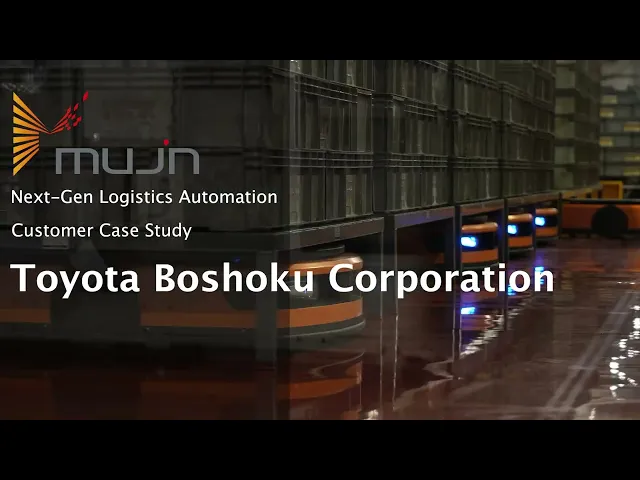
Case Study: Toyota Automates Factory Logistics with MujinOS
Toyota Boshoku Accelerates Logistics DX with Mujin Intelligent Automation
Customer: Toyota Boshoku Corporation, a leading global automotive parts manufacturer
Location: Sanage Plant (Aichi, Japan)
Scope: Finished goods storage and transport automation
Background
Like many global manufacturers, Toyota Boshoku faced increasing pressure on its finished goods logistics operations. Growing product volumes, a wider mix of parts, and limited available floor space made traditional logistics processes difficult to scale.
At the same time, labor shortages and physically demanding manual handling created urgency to rethink how finished goods were stored and transported. While production lines were already highly automated, logistics required a software-driven approach capable of delivering flexibility, visibility, and long-term scalability.
Need to automate palletizing? Contact Us
Challenges
Toyota identified several key challenges:
Scaling finished goods logistics within a fixed factory footprint
Reducing manual handling of heavy returnable totes (10+ kg)
Achieving high-accuracy palletizing across diverse product types
Moving beyond fixed, location-based storage toward a more flexible model
Establishing real-time visibility and traceability across logistics operations
Standardizing logistics control to support future expansion and replication
Solution
Mujin designed and delivered an integrated finished goods storage and transport system, combining robotics, AGVs, and logistics software under a single intelligent software platform.
The solution includes:
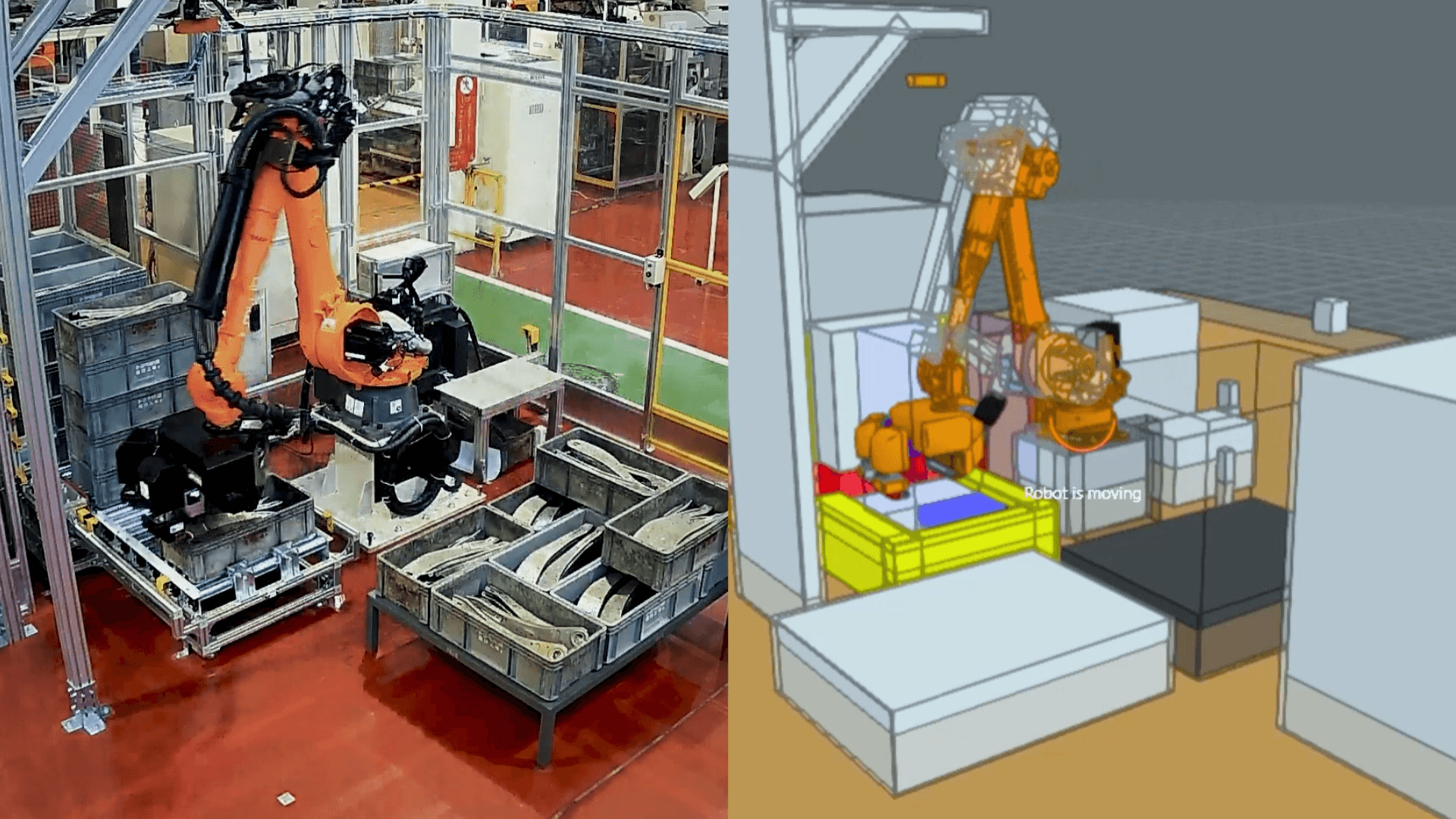
A high-precision palletizing robot for returnable totes, powered by Mujin’s intelligent motion planning and 3D vision
Seven AGVs, centrally orchestrated to enable flexible, automated transport
An integrated Warehouse Execution System (WES) for logistics control and visualization
Dynamic, location-free storage logic, replacing fixed shelving with real-time space optimization
Digital twin–based visualization for live monitoring, traceability, and continuous improvement
All components are fully orchestrated by MujinOS, enabling seamless coordination between robots, AGVs, and storage operations.
Results
The automation system was fully operational in approximately six months, from planning to launch
Thousands of heavy returnable totes are now handled automatically, significantly reducing physical workload
Space utilization improved through dynamic storage allocation without fixed locations
Accuracy and traceability enhanced through QR code verification and real-time visual monitors
Centralized control enabled greater operational flexibility and simplified system scaling
Long-Term Impact
This project demonstrates how manufacturers can move beyond isolated automation toward software-defined logistics systems that are scalable, interoperable, and future-ready.
By combining intelligent robot control, AGV orchestration, and digital twin visualisation within a single platform, Toyota Boshoku established a foundation for continuous improvement and logistics DX—without being locked into fixed layouts or rigid automation structures.
Toyota Boshoku Accelerates Logistics DX with Mujin Intelligent Automation
Customer: Toyota Boshoku Corporation, a leading global automotive parts manufacturer
Location: Sanage Plant (Aichi, Japan)
Scope: Finished goods storage and transport automation
Background
Like many global manufacturers, Toyota Boshoku faced increasing pressure on its finished goods logistics operations. Growing product volumes, a wider mix of parts, and limited available floor space made traditional logistics processes difficult to scale.
At the same time, labor shortages and physically demanding manual handling created urgency to rethink how finished goods were stored and transported. While production lines were already highly automated, logistics required a software-driven approach capable of delivering flexibility, visibility, and long-term scalability.
Need to automate palletizing? Contact Us
Challenges
Toyota identified several key challenges:
Scaling finished goods logistics within a fixed factory footprint
Reducing manual handling of heavy returnable totes (10+ kg)
Achieving high-accuracy palletizing across diverse product types
Moving beyond fixed, location-based storage toward a more flexible model
Establishing real-time visibility and traceability across logistics operations
Standardizing logistics control to support future expansion and replication
Solution
Mujin designed and delivered an integrated finished goods storage and transport system, combining robotics, AGVs, and logistics software under a single intelligent software platform.
The solution includes:
A high-precision palletizing robot for returnable totes, powered by Mujin’s intelligent motion planning and 3D vision
Seven AGVs, centrally orchestrated to enable flexible, automated transport
An integrated Warehouse Execution System (WES) for logistics control and visualization
Dynamic, location-free storage logic, replacing fixed shelving with real-time space optimization
Digital twin–based visualization for live monitoring, traceability, and continuous improvement
All components are fully orchestrated by MujinOS, enabling seamless coordination between robots, AGVs, and storage operations.
Results
The automation system was fully operational in approximately six months, from planning to launch
Thousands of heavy returnable totes are now handled automatically, significantly reducing physical workload
Space utilization improved through dynamic storage allocation without fixed locations
Accuracy and traceability enhanced through QR code verification and real-time visual monitors
Centralized control enabled greater operational flexibility and simplified system scaling
Long-Term Impact
This project demonstrates how manufacturers can move beyond isolated automation toward software-defined logistics systems that are scalable, interoperable, and future-ready.
By combining intelligent robot control, AGV orchestration, and digital twin visualisation within a single platform, Toyota Boshoku established a foundation for continuous improvement and logistics DX—without being locked into fixed layouts or rigid automation structures.
Media contact
marketing@mujin-europe.com
Have a question?
Learn how MujinOS delivers real-time perception, motion control, and no-code deployment—across any robotic system
Have a question?
Learn how MujinOS delivers real-time perception, motion control, and no-code deployment—across any robotic system