Technology
Learn about the platform powering today's most advanced automation applications


Technology
Learn about the platform powering today's most advanced automation applications
Technology
Learn about the platform powering today's most advanced automation applications
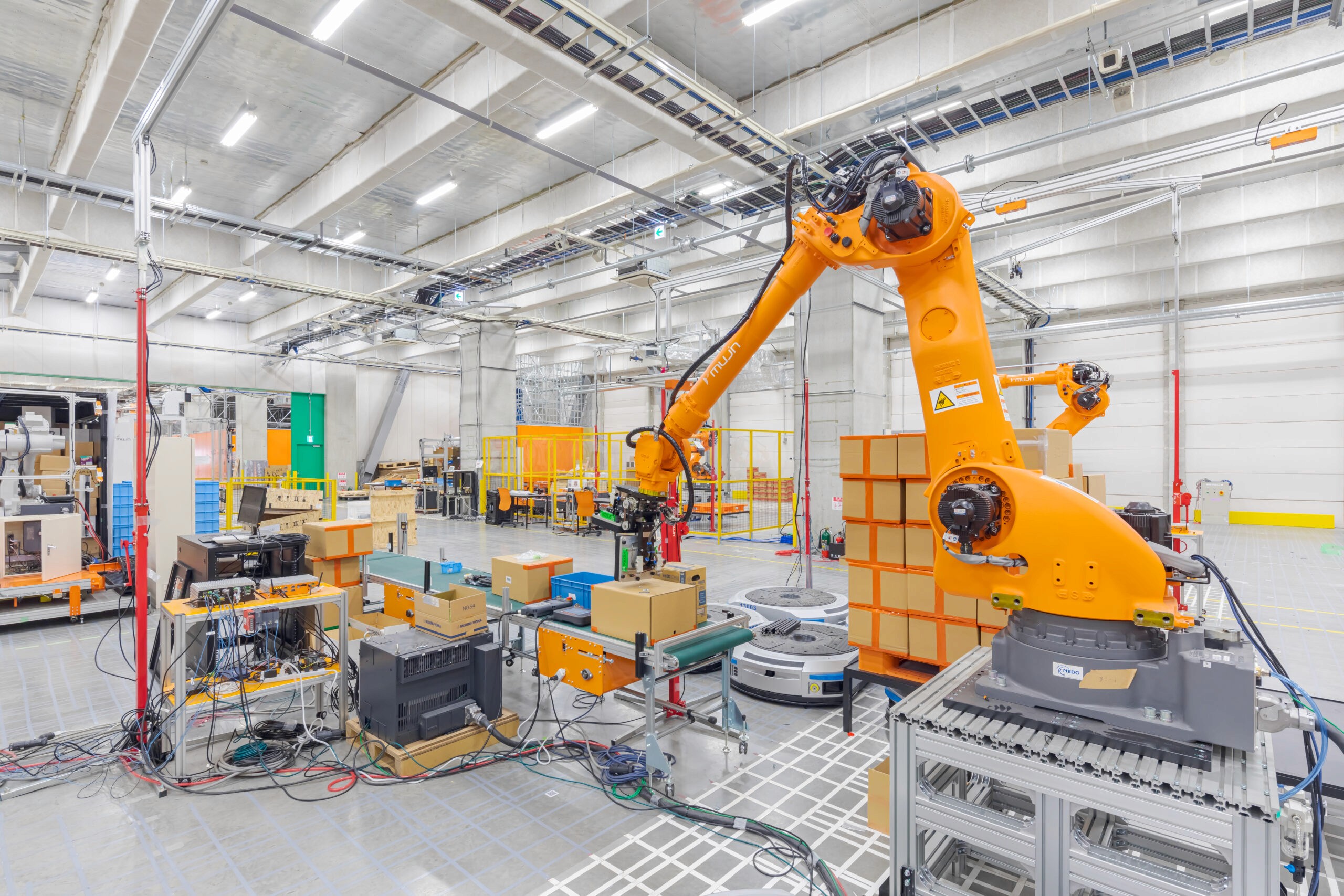
Physical AI Is Moving From Hype to Industrial Necessity
Physical AI Is Moving From Hype to Industrial Necessity
Physical AI Is No Longer a Future Concept
It is becoming a requirement for industries facing labor shortages, increasing operational complexity, and growing pressure to maintain productivity.
Across manufacturing, logistics, and infrastructure, the role of automation is changing. What was once driven by efficiency is now driven by necessity.
In markets like Japan, this shift is especially visible. A shrinking workforce and long-term demographic pressure are accelerating the adoption of robotics and AI-powered systems—not as an optimization tool, but as a way to sustain operations.
As highlighted in a recent article by TechCrunch, physical AI is emerging as a critical response to these structural challenges, with increasing investment focused on real-world deployment rather than experimentation.
The Real Shift: From Pilots to Production
For years, automation projects often remained stuck in pilot phases which are technically promising, but difficult to scale.
That is changing.
Today, the focus has moved to:
Customer-paid deployments instead of vendor-funded trials
Reliable, full-shift operation in real environments
Measurable performance: uptime, throughput, and reduced human intervention
This marks a fundamental transition:
from testing automation → to depending on it.
Industrial environments no longer have the luxury of fragmented systems or experimental setups. They require solutions that work continuously, adapt dynamically, and deliver predictable outcomes.
Why Hardware Alone Is Not Enough
Robotics innovation has historically been driven by hardware like robots, sensors, and actuators.
While hardware remains essential, it is no longer the limiting factor. As noted by Issei Takino, co-founder of Mujin, scaling robotics requires more than hardware; it depends on software platforms that can unlock autonomy and efficiency across existing systems.
The real bottleneck today is integration and orchestration:
Connecting multiple machines into a unified system
Adapting to variability in real-world environments
Managing operations across robots, conveyors, and mobile systems
Continuously improving performance after deployment
This is where many automation projects fail. Not because the hardware is insufficient, but because the system cannot operate as a cohesive whole.
Where the Real Value Is Emerging
As the industry evolves, value is shifting toward:
Orchestration software
Digital twins
Real-time control systems
Integration platforms
In other words, the intelligence layer that sits above hardware.
The most defensible advantage is no longer just building machines. It is enabling those machines to:
Work together
Adapt in real time
Scale across operations
Improve continuously
Mujin’s Perspective: Automation That Actually Works in the Real World
At Mujin, this shift is at the core of how we approach robotics.
The challenge is no longer whether to automate.
It is how to deploy automation that works reliably in complex, real-world environments.
MujinOS is designed as a hardware-agnostic, software-defined platform that:
Unifies perception, planning, and motion control
Enables teachless operation, no manual programming
Uses a real-time digital twin to synchronize and optimize systems
Orchestrates robots, AGVs, and peripherals as one coordinated system
This approach allows companies to move beyond isolated automation cells and toward fully integrated, scalable operations.
From Automation to Physical AI
Physical AI represents more than just smarter robots.
It represents a shift toward systems that:
Make decisions in real time
Adapt to changing conditions
Operate with minimal human intervention
Continuously improve through data and execution
But achieving this requires more than AI models or advanced hardware.
It requires a platform that bridges digital intelligence with physical execution.
The Future Will Be Defined by Deployment, Not Technology
The next phase of industrial automation will not be won by the most advanced robot or the most sophisticated AI model.
It will be defined by:
Who can deploy systems fastest
Who can integrate across complexity
Who can maintain and improve performance over time
Physical AI is not about replacing humans.
It is about enabling industries to continue operating, scaling, and evolving in a world where traditional approaches are no longer sufficient.
Conclusion
The shift is already happening.
Automation is no longer optional.
And physical AI is no longer experimental.
The companies that succeed will be those that move beyond isolated technologies and embrace intelligent, orchestrated systems built for real-world performance.
Physical AI Is No Longer a Future Concept
It is becoming a requirement for industries facing labor shortages, increasing operational complexity, and growing pressure to maintain productivity.
Across manufacturing, logistics, and infrastructure, the role of automation is changing. What was once driven by efficiency is now driven by necessity.
In markets like Japan, this shift is especially visible. A shrinking workforce and long-term demographic pressure are accelerating the adoption of robotics and AI-powered systems—not as an optimization tool, but as a way to sustain operations.
As highlighted in a recent article by TechCrunch, physical AI is emerging as a critical response to these structural challenges, with increasing investment focused on real-world deployment rather than experimentation.
The Real Shift: From Pilots to Production
For years, automation projects often remained stuck in pilot phases which are technically promising, but difficult to scale.
That is changing.
Today, the focus has moved to:
Customer-paid deployments instead of vendor-funded trials
Reliable, full-shift operation in real environments
Measurable performance: uptime, throughput, and reduced human intervention
This marks a fundamental transition:
from testing automation → to depending on it.
Industrial environments no longer have the luxury of fragmented systems or experimental setups. They require solutions that work continuously, adapt dynamically, and deliver predictable outcomes.
Why Hardware Alone Is Not Enough
Robotics innovation has historically been driven by hardware like robots, sensors, and actuators.
While hardware remains essential, it is no longer the limiting factor. As noted by Issei Takino, co-founder of Mujin, scaling robotics requires more than hardware; it depends on software platforms that can unlock autonomy and efficiency across existing systems.
The real bottleneck today is integration and orchestration:
Connecting multiple machines into a unified system
Adapting to variability in real-world environments
Managing operations across robots, conveyors, and mobile systems
Continuously improving performance after deployment
This is where many automation projects fail. Not because the hardware is insufficient, but because the system cannot operate as a cohesive whole.
Where the Real Value Is Emerging
As the industry evolves, value is shifting toward:
Orchestration software
Digital twins
Real-time control systems
Integration platforms
In other words, the intelligence layer that sits above hardware.
The most defensible advantage is no longer just building machines. It is enabling those machines to:
Work together
Adapt in real time
Scale across operations
Improve continuously
Mujin’s Perspective: Automation That Actually Works in the Real World
At Mujin, this shift is at the core of how we approach robotics.
The challenge is no longer whether to automate.
It is how to deploy automation that works reliably in complex, real-world environments.
MujinOS is designed as a hardware-agnostic, software-defined platform that:
Unifies perception, planning, and motion control
Enables teachless operation, no manual programming
Uses a real-time digital twin to synchronize and optimize systems
Orchestrates robots, AGVs, and peripherals as one coordinated system
This approach allows companies to move beyond isolated automation cells and toward fully integrated, scalable operations.
From Automation to Physical AI
Physical AI represents more than just smarter robots.
It represents a shift toward systems that:
Make decisions in real time
Adapt to changing conditions
Operate with minimal human intervention
Continuously improve through data and execution
But achieving this requires more than AI models or advanced hardware.
It requires a platform that bridges digital intelligence with physical execution.
The Future Will Be Defined by Deployment, Not Technology
The next phase of industrial automation will not be won by the most advanced robot or the most sophisticated AI model.
It will be defined by:
Who can deploy systems fastest
Who can integrate across complexity
Who can maintain and improve performance over time
Physical AI is not about replacing humans.
It is about enabling industries to continue operating, scaling, and evolving in a world where traditional approaches are no longer sufficient.
Conclusion
The shift is already happening.
Automation is no longer optional.
And physical AI is no longer experimental.
The companies that succeed will be those that move beyond isolated technologies and embrace intelligent, orchestrated systems built for real-world performance.
Media contact
marketing@mujin-europe.com
Have a question?
Learn how MujinOS delivers real-time perception, motion control, and no-code deployment—across any robotic system
Have a question?
Learn how MujinOS delivers real-time perception, motion control, and no-code deployment—across any robotic system