Technology
Learn about the platform powering today's most advanced automation applications


Technology
Learn about the platform powering today's most advanced automation applications
Technology
Learn about the platform powering today's most advanced automation applications
Most Automation Fails Because Integration Is the Problem
Most Automation Fails Because Integration Is the Problem
Adding robots should not mean re-engineering your warehouse.
Across Europe, warehouses are investing heavily in robotics. Palletizing systems, depalletizing cells, mobile robots, and piece picking solutions are becoming standard components of modern operations.
Yet many automation projects stall. Not because robots fail.
But because integration becomes the bottleneck.
Each new robot introduces new interfaces, safety coordination, PLC logic, middleware layers, and custom engineering. What was intended to improve flexibility often increases system complexity instead.
The result is slower deployment, higher integration costs, and automation that becomes difficult to scale.
The issue is not robotics.
The issue is fragmented control architecture.
The Hidden Burden on System Integrators
For system integrators, this fragmentation creates a recurring challenge.
Every project requires:
Custom PLC programming
Motion scripting
Interface stitching between vendors
Vision calibration
Safety validation across disconnected systems
Even similar projects must often be rebuilt from scratch because there is no unified orchestration layer.
This approach limits scalability and increases project risk.
As warehouse automation becomes more dynamic, integrators need platforms that accelerate deployment rather than multiply engineering effort.
From Hardware-Centric to Software-Defined Automation
Mujin Europe approaches automation differently.
Instead of integrating robots one by one, we deploy a unified control architecture powered by MujinOS.
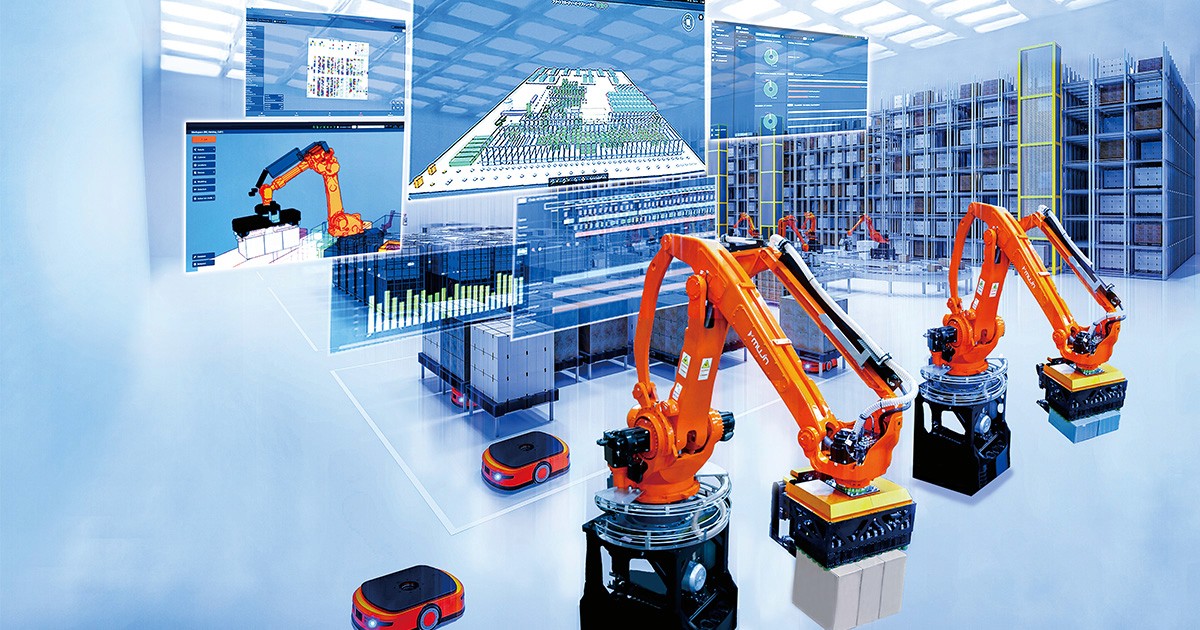
MujinOS operates as the software backbone of industrial automation. It orchestrates robots, conveyors, sensors, and peripherals under one intelligent control layer. The system is hardware-agnostic and designed to coordinate multiple robotic applications simultaneously.
Palletizing, depalletizing, and mobile robotics do not function as isolated cells. They operate as synchronized components of a closed-loop system.
Integration is not rebuilt each time a new robot is added.
It is extended.
Configurable Modules Instead of Custom Code
For system integrators, this shift changes the economics of robotics projects.
MujinOS includes pre-integrated functional modules that allow workflows to be configured rather than programmed. Instead of writing repetitive PLC logic and motion scripts, integrators select applications, define parameters, model the scene, and deploy through a structured configuration workflow.
This teachless, no-code approach reduces engineering time and ensures consistent behavior across projects.
Reusable templates for palletizing, depalletizing, and robotic coordination enable integrators to scale solutions without starting from zero.
Once deployed, built-in capabilities such as automatic collision avoidance, adaptive motion planning, and real-time system visibility ensure predictable and robust operation.
Automation becomes a platform strategy rather than a one-off engineering project.
Scalable Orchestration in Real Warehouse Conditions
In real logistics environments, automation rarely exists in isolation.
Inbound pallets must be depalletized.
Products are transported across zones.
Outbound orders are palletized.
Each step depends on timing, sequencing, spatial awareness, and dynamic adaptation.
MujinOS enables:
Real-time multi-robot orchestration
Coordinated interaction between fixed and mobile robotics
Continuous spatial reasoning and motion optimization
Centralized visibility across the system
Because intelligence resides in the platform rather than isolated scripts, the system continuously evaluates its environment and calculates optimal actions.
This architecture enables scalable automation without re-engineering the foundation each time operations expand.
A Platform Approach for Integrators and End Users
Supporting integrators does not end at deployment. Mujin Europe provides technical collaboration, project support, and joint development to ensure long-term success.
As warehouse automation evolves, the shift toward software-defined orchestration is becoming essential.
Automation must scale through configuration, not reconstruction.
Become a Mujin Integration Partner
As automation shifts from hardware-centric projects to software-defined platforms, the role of system integrators becomes even more critical.
Mujin Europe collaborates with integrators who want to scale robotics deployments without multiplying engineering complexity.
If you are looking to expand your automation portfolio with a hardware-agnostic, configurable robotics platform, we invite you to explore partnership opportunities.
Learn more about becoming a Mujin integration partner
Adding robots should not mean re-engineering your warehouse.
Across Europe, warehouses are investing heavily in robotics. Palletizing systems, depalletizing cells, mobile robots, and piece picking solutions are becoming standard components of modern operations.
Yet many automation projects stall. Not because robots fail.
But because integration becomes the bottleneck.
Each new robot introduces new interfaces, safety coordination, PLC logic, middleware layers, and custom engineering. What was intended to improve flexibility often increases system complexity instead.
The result is slower deployment, higher integration costs, and automation that becomes difficult to scale.
The issue is not robotics.
The issue is fragmented control architecture.
The Hidden Burden on System Integrators
For system integrators, this fragmentation creates a recurring challenge.
Every project requires:
Custom PLC programming
Motion scripting
Interface stitching between vendors
Vision calibration
Safety validation across disconnected systems
Even similar projects must often be rebuilt from scratch because there is no unified orchestration layer.
This approach limits scalability and increases project risk.
As warehouse automation becomes more dynamic, integrators need platforms that accelerate deployment rather than multiply engineering effort.
From Hardware-Centric to Software-Defined Automation
Mujin Europe approaches automation differently.
Instead of integrating robots one by one, we deploy a unified control architecture powered by MujinOS.
MujinOS operates as the software backbone of industrial automation. It orchestrates robots, conveyors, sensors, and peripherals under one intelligent control layer. The system is hardware-agnostic and designed to coordinate multiple robotic applications simultaneously.
Palletizing, depalletizing, and mobile robotics do not function as isolated cells. They operate as synchronized components of a closed-loop system.
Integration is not rebuilt each time a new robot is added.
It is extended.
Configurable Modules Instead of Custom Code
For system integrators, this shift changes the economics of robotics projects.
MujinOS includes pre-integrated functional modules that allow workflows to be configured rather than programmed. Instead of writing repetitive PLC logic and motion scripts, integrators select applications, define parameters, model the scene, and deploy through a structured configuration workflow.
This teachless, no-code approach reduces engineering time and ensures consistent behavior across projects.
Reusable templates for palletizing, depalletizing, and robotic coordination enable integrators to scale solutions without starting from zero.
Once deployed, built-in capabilities such as automatic collision avoidance, adaptive motion planning, and real-time system visibility ensure predictable and robust operation.
Automation becomes a platform strategy rather than a one-off engineering project.
Scalable Orchestration in Real Warehouse Conditions
In real logistics environments, automation rarely exists in isolation.
Inbound pallets must be depalletized.
Products are transported across zones.
Outbound orders are palletized.
Each step depends on timing, sequencing, spatial awareness, and dynamic adaptation.
MujinOS enables:
Real-time multi-robot orchestration
Coordinated interaction between fixed and mobile robotics
Continuous spatial reasoning and motion optimization
Centralized visibility across the system
Because intelligence resides in the platform rather than isolated scripts, the system continuously evaluates its environment and calculates optimal actions.
This architecture enables scalable automation without re-engineering the foundation each time operations expand.
A Platform Approach for Integrators and End Users
Supporting integrators does not end at deployment. Mujin Europe provides technical collaboration, project support, and joint development to ensure long-term success.
As warehouse automation evolves, the shift toward software-defined orchestration is becoming essential.
Automation must scale through configuration, not reconstruction.
Become a Mujin Integration Partner
As automation shifts from hardware-centric projects to software-defined platforms, the role of system integrators becomes even more critical.
Mujin Europe collaborates with integrators who want to scale robotics deployments without multiplying engineering complexity.
If you are looking to expand your automation portfolio with a hardware-agnostic, configurable robotics platform, we invite you to explore partnership opportunities.
Learn more about becoming a Mujin integration partner
Media contact
marketing@mujin-europe.com
Have a question?
Learn how MujinOS delivers real-time perception, motion control, and no-code deployment—across any robotic system
Have a question?
Learn how MujinOS delivers real-time perception, motion control, and no-code deployment—across any robotic system